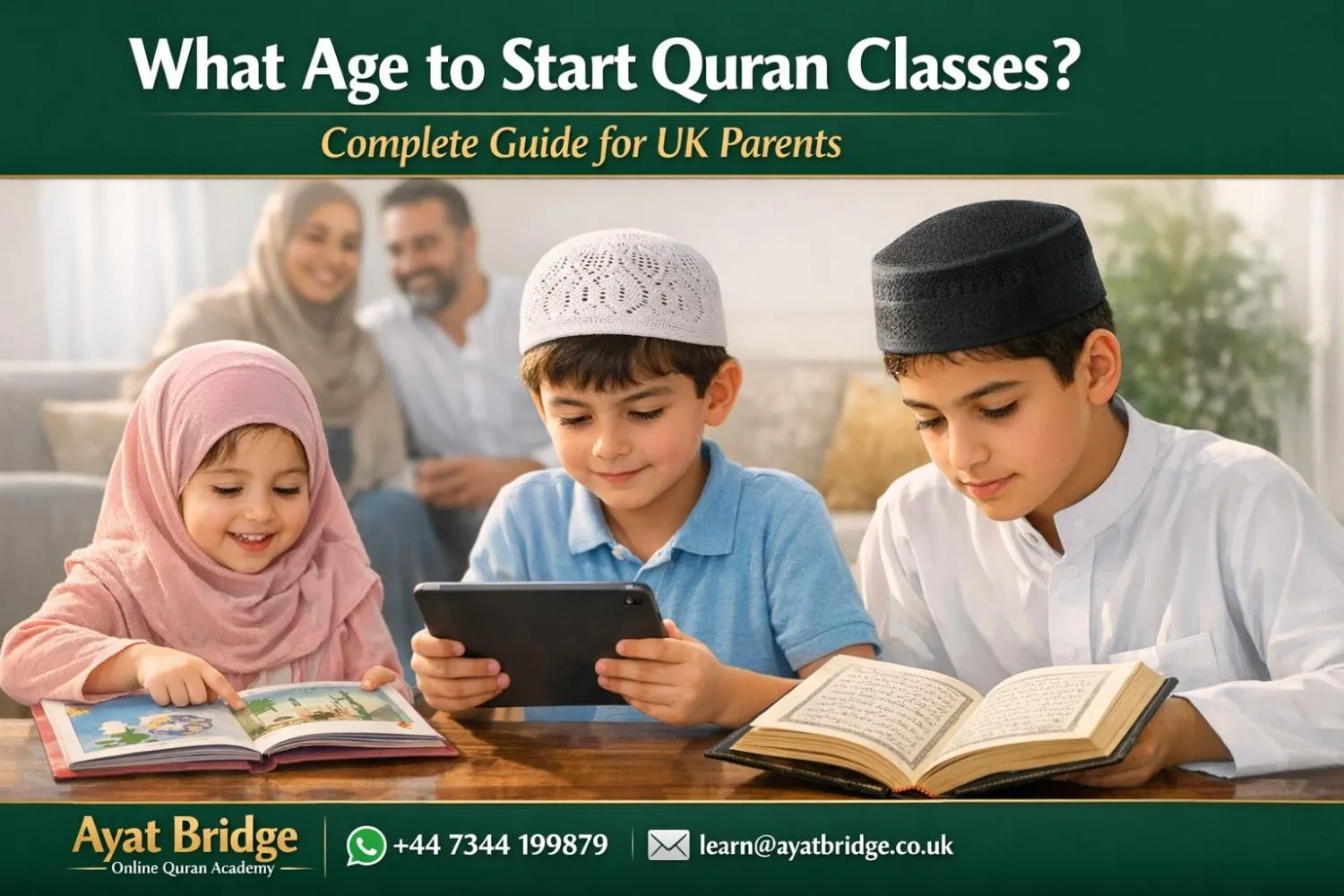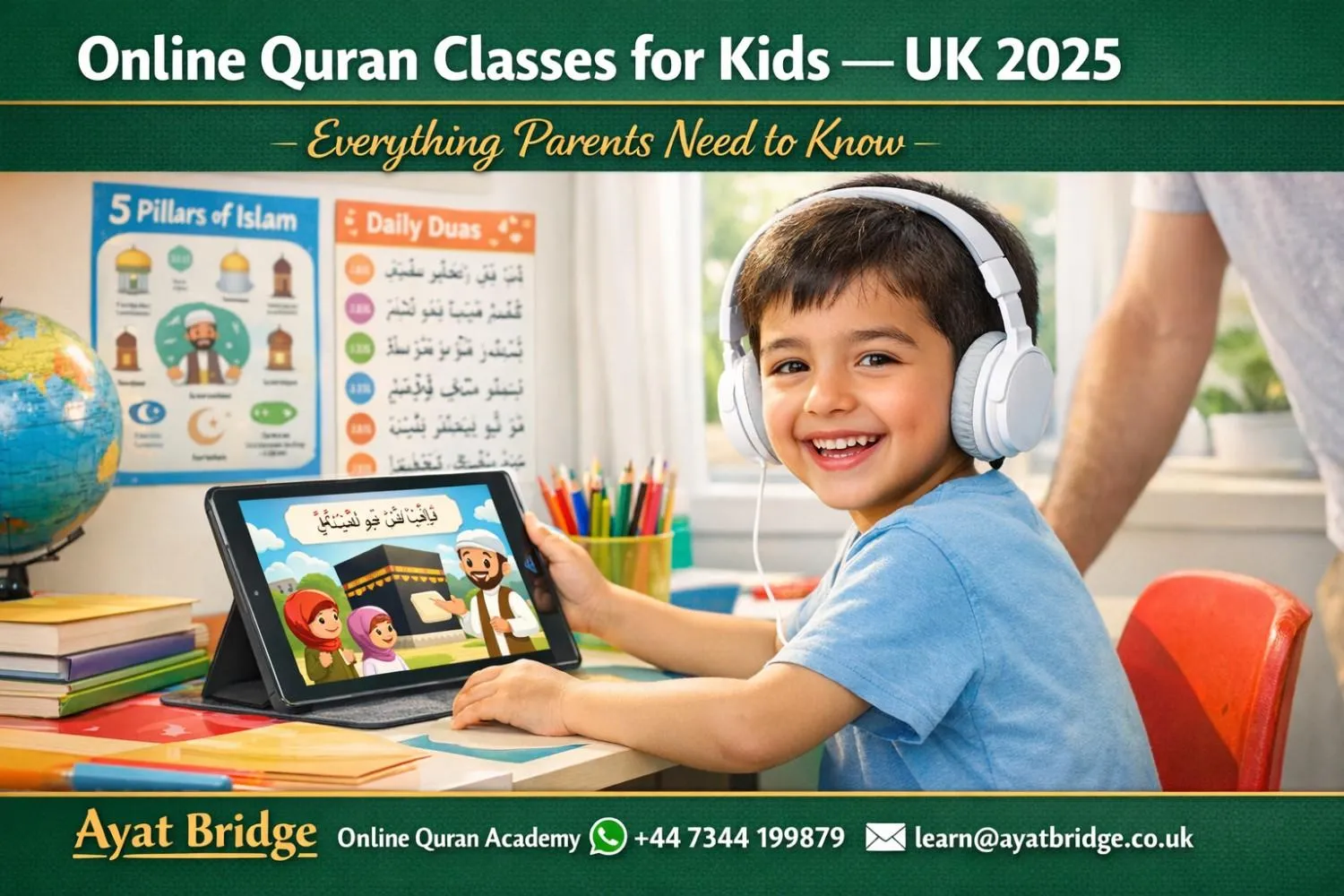
Online Quran classes for children have transformed how UK Muslim families approach Quran education. Here is the complete 2026 guide — how classes work, what the 4-stage curriculum looks like, what to look for in a teacher, scheduling, and why the first class at Ayat Bridge is free
Introduction — How Quran Education for UK Kids Changed Forever
Ten years ago, if a Muslim family in Birmingham wanted their child to learn the Quran, the options were limited: the local mosque (often overcrowded), a private home teacher (expensive and unreliable), or nothing. The choice was constrained by geography, availability, and cost.
Today, that constraint no longer exists. Online Quran classes for children have given every Muslim family in the UK — regardless of where they live, what their schedule looks like, or whether their local mosque has capacity — access to certified, qualified, one-to-one Quran teachers for their children.
At Ayat Bridge, we have taught hundreds of UK children from age 4 through to teenagers completing their Tajweed and beginning Hifz. Parents often tell us the same thing: 'I wish this had existed when I was growing up.' It exists now. And this guide tells you exactly how it works.
How Online Quran Classes for Kids Actually Work
The first question most parents ask is: 'Will my child actually engage with a screen for Quran learning?' The answer, consistently, is yes — especially because of what makes online one-to-one classes different from any other screen activity.
A YouTube video is passive. A child watches, but there is no interaction, no feedback, no relationship. An online Quran class is the opposite. There is a real person on the screen — a teacher who knows your child, who speaks to them directly, who listens to them recite, who praises them when they get something right and patiently corrects them when they do not. Children respond to this relationship in exactly the same way they respond to any caring adult who pays them real attention.
What a typical session looks like at Ayat Bridge: Your child sits at a desk with a tablet, laptop, or PC. The teacher appears on screen at the scheduled time. The class begins with a warm greeting — teachers at Ayat Bridge are specifically trained to establish a positive, encouraging tone at the start of every session. The child recites the previous lesson's portion. The teacher listens carefully. Corrections are made with patience — never with frustration. New material is introduced. The child practises. Homework is set. The session ends.
For children aged 4 to 6, sessions are 25 to 30 minutes — the optimal attention span for this age group. For older children, sessions run 45 to 60 minutes.
What Your Child Will Learn — The Online Quran Curriculum at Ayat Bridge
Stage 1 — Noorani Qaida: Every child begins here, regardless of age. The Qaida introduces all Arabic letters, their sounds, how they join, and how to read basic Quranic words. Duration: typically 3 to 6 months depending on age and frequency of classes. This is the foundation that everything else is built upon — and it must be done properly.
Stage 2 — Quran Reading (Naazirah): Once the Qaida is complete, the child opens the Quran itself. They begin with Surah Al-Fatiha — the Surah they will recite 17 times daily in Salah for the rest of their life — and work through the Quran chapter by chapter. This stage builds reading fluency and confidence.
Stage 3 — Tajweed: The rules of correct Quran recitation are introduced progressively from the beginning of Quran reading and become the focus of dedicated lessons as the child progresses. Ayat Bridge teachers are Ijazah certified — meaning they carry the authentic chain of Quranic recitation.
Stage 4 — Hifz (Optional): For children who wish to memorise the Quran, Ayat Bridge offers dedicated Hifz programmes. Many children begin with Juzz Amma — the 30th Para — and work towards memorising further.
What to Look for in an Online Quran Teacher for Your Child
The teacher is everything. The curriculum, the technology, the platform — all of these matter far less than the quality and suitability of the person teaching your child. Here is what to verify before committing:
• Hafiz ul Quran: the teacher has memorised the complete Quran — this is the foundational Quranic credential
• Ijazah certified: the teacher has a formal, chain-linked certificate of Quran recitation going back to the Prophet (peace be upon him)
• Child specialist: the teacher has specific experience teaching children in the age group of your child — teaching a 5-year-old requires completely different skills from teaching a 12-year-old
• DBS checked: the standard UK safeguarding check. Any teacher working with UK children online should have this. At Ayat Bridge it is mandatory for all teachers
• Warm, patient personality: you can assess this in the free trial class. Watch how the teacher handles a moment when your child makes a mistake or gets distracted — that tells you everything
The Difference Between Ayat Bridge and Other Online Quran Platforms
1. Named teachers, not 'a teacher will be assigned': Before your child's first paid class, you know who their teacher is, what their qualifications are, and what their teaching experience includes. At Ayat Bridge this is standard. At many other platforms, it is not.
2. Teacher-student personality matching: Ayat Bridge makes a deliberate effort to match each child with a teacher suited to their personality and learning style. If the match is not right after the first few sessions, the teacher is changed at no extra cost.
3. Female teachers always available: For families who prefer a female teacher for their daughter — or for any child — certified Ustadhat are always available at Ayat Bridge across all time zones and at all session times.
4. Parent updates: After each session, parents can request a brief update on their child's progress. Monthly progress summaries are available. You are always informed about where your child is in their Quran journey.
Scheduling — Making Online Quran Classes Work for Your Family
The most common reason families tell us they previously struggled with mosque Quran classes is timing. Evening classes at 5pm clash with homework, dinner, and tired children. Weekend classes compete with family activities and sports.
At Ayat Bridge, classes are available from 7am to 10pm, 7 days a week. This means:
• Before school (7am to 8am) — for children who are sharp in the morning
• After school (4pm to 6pm) — the most popular slot for primary school children
• Weekend mornings (8am to 12pm) — perfect for families who prefer keeping weekdays clear
• Weekend afternoons — for families where mornings are activities and sports
• Evening (after Maghrib) — for families whose routine works better later
You choose the time. You choose the frequency. You change the time if your schedule changes. Flexibility is not a feature at Ayat Bridge — it is the foundation of the service.
📚 Start Your Online Quran Journey — First Class FREE
Give your child the gift of the Quran — properly taught, with a certified teacher, from the comfort of your home. The first class at Ayat Bridge is completely free. No payment. No commitment. Just your child, their teacher, and the beginning of a lifelong connection with the Quran. Book at ayatbridge.co.uk