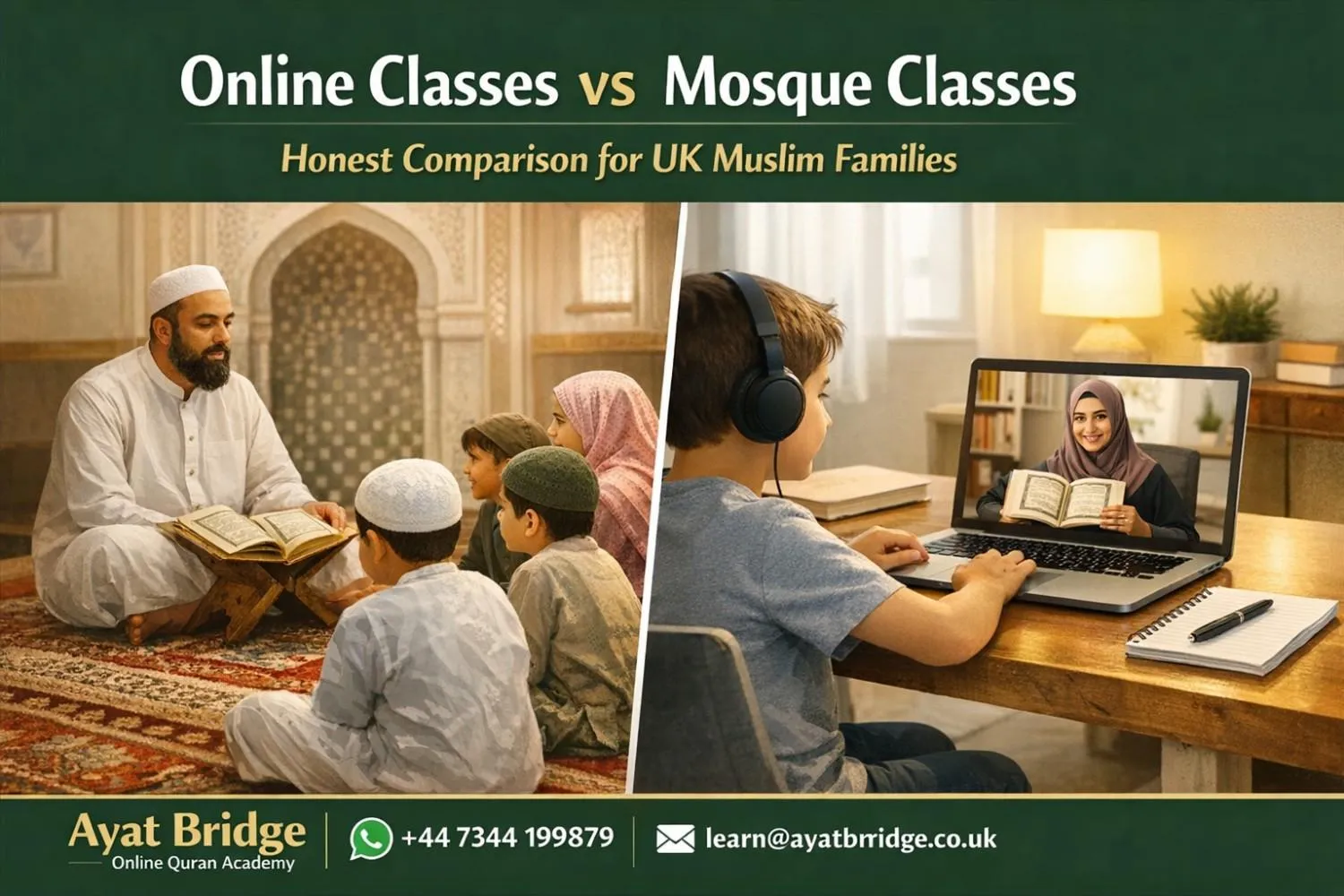
Should your family learn Quran online or at the local mosque? This is the honest, unbiased comparison UK Muslim families need — real advantages and real limitations of both, and how the best families in 2025 use both together.
Introduction — A Question With No Universal Answer
Every few months, a parent in the UK asks us this question. 'We have a good local mosque with Quran classes — should we use those, or come to Ayat Bridge online?' The honest answer is: it depends on your family. And sometimes the best answer is: both.
This article is not written to sell you online classes. It is written to give you a genuinely honest comparison so that whatever you decide, you decide with accurate information. Mosque classes have built generations of Quran readers. Online classes have transformed access for millions of families. Neither is universally better. Each has real, specific advantages — and real, specific limitations.
Here is the comparison you actually need.
Local Mosque Classes — The Real Advantages
1. Community and Belonging — The most irreplaceable advantage of mosque classes is the community they create. Your child sits alongside other Muslim children from the local area. They form friendships. They grow up knowing who the Muslim families in their neighbourhood are. They become part of something larger than their own home. This social dimension — being part of a Muslim peer group — is genuinely valuable and is something online classes cannot fully replicate.
2. The Atmosphere of the Mosque — There is something different about learning inside a mosque. The adab (Islamic etiquette) required in a masjid is itself a lesson. Children who learn in a mosque environment internalise the sanctity of Islamic spaces. They learn to lower their voices, to behave with respect, to treat the space of learning with reverence.
3. Free or Very Low Cost — Many UK mosque Quran classes run on a donation basis — free or a very small monthly contribution. This makes Quran education accessible to all families regardless of income.
4. A Living Scholar in the Community — Having a local scholar who knows your child, who sees them at Jummah, who can answer Islamic questions beyond just Quran reading — this is a relationship that matters. It is a mentorship that extends beyond the classroom.
Local Mosque Classes — The Real Challenges in 2025
1. Timing That Works Against Children — Most mosque Quran classes run between 4pm and 7pm on weekday evenings. This is precisely when children are most tired — they have spent 7 hours at school, done their homework, and now they are required to go out again for another lesson. For many children, this timing consistently puts Quran in direct competition with rest, dinner, and family time. The result is resistance, low engagement, and slow progress.
2. Group Teaching Limits Individual Progress — A typical mosque class has between 10 and 30 children at various ages and levels. The teacher — however skilled — must teach to the group. Children who are ahead cannot be pushed forward. Children who are struggling cannot be slowed down. The pace is always a compromise. This is not a criticism of mosque teachers — it is the inherent limitation of group teaching as a format.
3. Waiting Lists in UK Cities — In London, Birmingham, Manchester, Bradford, and Leicester — the five UK cities with the largest Muslim populations — mosque Quran classes are routinely oversubscribed. Many families wait 3 to 6 months for a place. During that wait, children get older and the window for the easiest learning narrows.
4. Inconsistent Teacher Qualifications — This is a sensitive point, but an important one. Mosque Quran teacher qualifications vary significantly across the UK. Some local mosque teachers are Hafiz ul Quran with Ijazah certification and decades of experience. Others are community volunteers who can read the Quran well but have no formal qualification in Tajweed or teaching methodology. As a parent, you often do not know which one is teaching your child.
Online Quran Classes — The Real Advantages
1. Complete Scheduling Flexibility — Online Quran classes happen at the time that works for your family. If your child is sharpest in the morning — before school. If evenings work better — evenings. Weekends only? Available. This flexibility means Quran class can happen when your child is actually alert and receptive, not when they are exhausted.
2. True One-to-One Teaching — Every session is between one student and one teacher. No group. No waiting for other students. The teacher's full attention is on your child for the entire session. They know exactly where your child is in their learning journey, what they struggled with last time, and what they need today. Progress in one-to-one teaching is significantly faster than group teaching for the vast majority of children.
3. Verified, Transparent Teacher Qualifications — Reputable online academies list their teachers' qualifications clearly — and they are verifiable. At Ayat Bridge, every teacher is Hafiz ul Quran, Ijazah certified, and has a minimum of 5 years teaching experience. This information is available before you even book a trial class.
4. No Geographic Limitation — You are not limited to teachers within driving distance. The best Quran teachers in the world are accessible to your child from your living room. If your local area has no strong Quran teachers — online classes solve this completely.
5. Female Teachers Always Available — Many UK mosques have limited availability of qualified female Quran teachers. For families who prefer a female teacher for sisters and daughters, online academies with dedicated female Ustadhat solve this completely.
Online Classes — The Honest Limitations
1. Less Peer Community — Your child learns alone, not alongside other Muslim children. The friendships and social bonds that form in mosque classes do not form in online one-to-one sessions.
2. Requires a Suitable Home Environment — The home needs to be distraction-free during class time. For some families, this is easy. For others — younger siblings, noise, small spaces — this requires active management.
3. Technology Dependency — Power cuts, internet interruptions, and device issues occasionally disrupt sessions. These are minor inconveniences — classes are easily rescheduled — but they are a factor that does not exist in person.
The Hybrid Approach — What Many UK Families Do
The most effective approach many UK Muslim families have found is to use both. Online classes at Ayat Bridge for structured, consistent, one-to-one Quran reading, Tajweed and progress — and the local mosque for Friday prayers, community, Islamic circle, and the social environment that mosque provides.
The child gets the best of both: the academic rigour of one-to-one certified teaching, and the community belonging that only a physical mosque environment can give.
📚 Ready to Start?
If online Quran classes are the right choice for your family, Ayat Bridge offers a completely free trial class to help you decide. No payment. No commitment. Just you and a certified teacher. Book at ayatbridge.co.uk